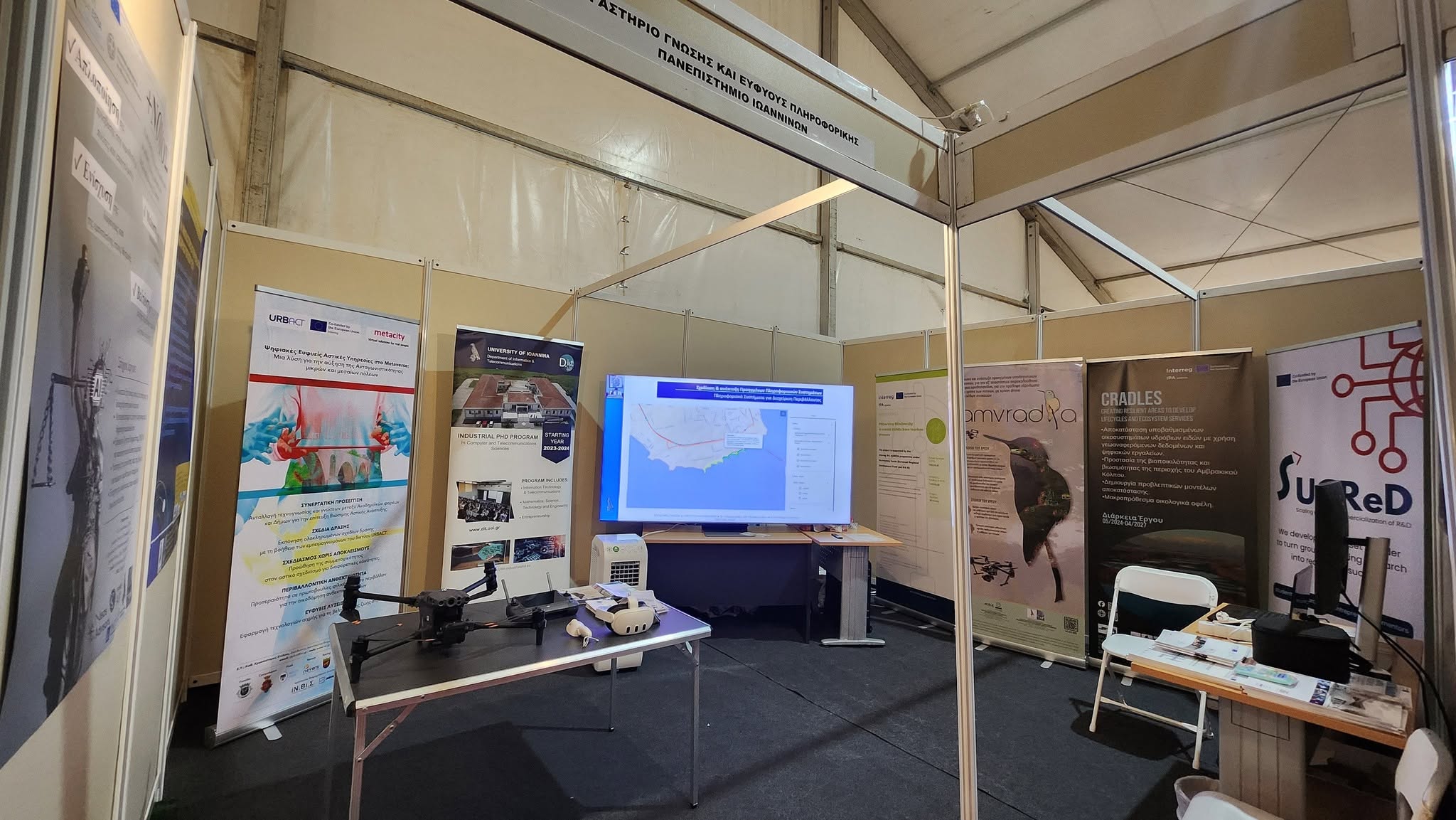
11th Panhellenic Exhibition of Arta 2025
We look forward to seeing you at the booth of the Knowledge and Intelligent Computing Laboratory of the Department of Informatics and Telecommunications at the University of Ioannina, at the 11th Panhellenic Exhibition of Arta 2025, where we are presenting innovative initiatives and applications in Artificial Intelligence, Machine Learning, Computer Vision, and Virtual Reality that have been developed by the Laboratory’s researchers as part of its research and development activities.
Visitors will have the opportunity to experience cutting-edge technologies firsthand and get a glimpse of how technology can transform the present and the future. In addition, they can learn about the commercial application of technology, the potential for creating tech startups, and how to turn a business idea into a successful enterprise.
The Laboratory’s research team is presenting two recent virtual reality applications it has developed:
- The first offers an interactive virtual tour of the Castle of Arta, highlighting points of interest within the walls. At the same time, visitors will have the opportunity to participate in an educational virtual reality game designed to provide insights into the history of Arta and the Castle. This activity will encourage collaboration, the pursuit of knowledge, and creativity among students.
- The second app allows students to explore a “digital replica” of the city of Arta from a bird’s-eye view, discovering its natural topography and major cultural landmarks. At the same time, the app will offer visitors the opportunity to learn about the history of each monument, combining digital exploration with cultural learning.
The following technological applications will also be presented at our booth:
- An advanced training system for operating small vessels, which utilizes virtual reality technologies. It offers realistic simulations under a variety of sailing conditions, contributing to the effective training of future and current small vessel skippers.
- An innovative computer vision system for monitoring and protecting the salt marsh ecosystem in the Rodia Lagoon. It uses satellite data in combination with aerial recordings via drones, providing valuable information for biodiversity conservation.
- An application of advanced computer vision techniques for the remote monitoring of wild bird populations in the Ambracian Gulf, with the aim of assessing the birds’ health status and, ultimately, preventing the spread of avian influenza through the use of drones, thermal cameras, and other specialized devices equipped with Artificial Intelligence.
- Methodologies and techniques for organizing and analyzing legislative texts with the help of artificial intelligence, making them more understandable and easily accessible. The goal is to create a platform that automatically identifies key points, provides summaries, and visualizes the connections between laws, thereby assisting citizens, lawyers, and researchers.
- An advanced online geographic information system (GIS) that integrates decision-support tools to optimize the management of water resources in the Arta region.
- Visitors will have the opportunity to see how young people with innovative ideas can start their own businesses. They will discover examples from the Green, Blue, and Circular Economies, learn about the importance of collaboration and mentorship, and be inspired to become “young entrepreneurs” themselves—using their knowledge and creativity to improve the world around them.